
If you print textiles for export, you've probably had this conversation with a buyer already. They want GOTS. Or OEKO-TEX. Or proof you're on the ZDHC list. And your line runs on solvent-heavy inks that were fine five years ago.
Switching sounds simple: buy different ink. It isn't. Change the ink and you change how it flows, how it cures, how it behaves on cotton versus a blend. Print quality drifts, rejects go up, and the line team loses faith in the new system fast.
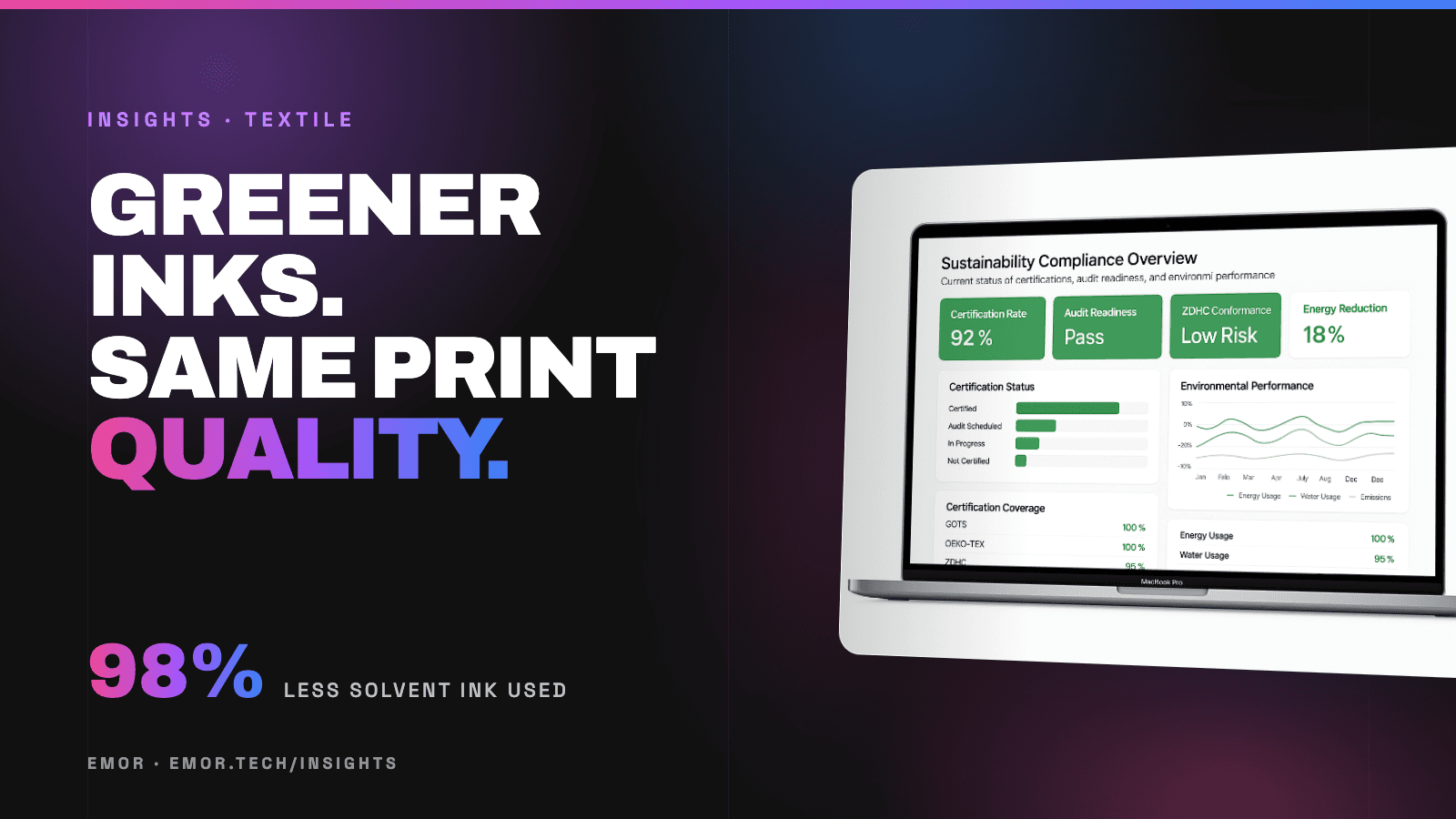
We worked through exactly this with Garisol. Over six months we moved their printing from solvent-based to water-based, non-PVC ink systems. Solvent ink use dropped by 98%, ink waste fell by 20%, and print consistency actually improved. Here's how.
Why "just change the ink" fails
Three things usually go wrong:
- Inconsistent quality across fabrics. An ink that's perfect on one fabric bleeds or cracks on another.
- The machine isn't set up for it. Water-based inks need different feed rates and control than what the line was tuned for.
- Compliance is treated as paperwork. It isn't — it shapes which formulations you can use in the first place.
So the work is less about ink and more about process.
Step 1: start from the certification, not the ink
Before testing anything, we mapped what GOTS, OEKO-TEX and ZDHC actually require for Garisol's products and buyers. That rules out some chemistry immediately and saves weeks of testing inks you could never certify.
If you only take one thing from this post: decide which certifications you need first. It changes the whole shortlist.
Step 2: test like production, not like a lab
Lab results lie a little. A swatch that passes on the bench can fail after a real wash cycle on a real fabric.
So we ran lab-to-line test cycles — wash fastness and colour fastness on the fabrics Garisol actually prints, then the same tests on samples off the production line. Anything that only worked in the lab didn't make the cut.
Step 3: fix the machine side
This is the part people skip. Water-based inks behave differently in the feed system, so we built a customised ink feed and precision control setup for the new inks. Without it you get the inconsistency everyone blames on the ink.
It's also where the 20% cut in ink waste came from. Better control means less over-application and fewer rejects — which also means lower cost, not just greener prints.
Step 4: keep the paperwork honest
Certification support ran alongside the technical work, not after it. Documentation of the formulations, test results and process settings is what auditors look at — and it's much easier to build as you go.
The same thinking applies beyond inks
We've applied this lab-to-line approach on other textile chemistry projects too:
- Discharge printing paste — eight months of R&D on dry and denim discharge systems for whiter, sharper results, with fabric-wise curing and wash optimisation. It's eco-compliant, production validated and now running on three major lines.
- Binder optimisation for an industrial textile unit — machines kept clogging because of binder viscosity and flow problems. After tuning the formulation and training the operations and maintenance teams, clogging dropped by 90% and uptime went from 85% to 98%.
Different problems, same pattern: understand the chemistry, test on the real line, and make sure the people running the machines know why the settings changed.
Before you switch
Some honest questions to ask:
- Which certifications do your buyers actually require — and by when?
- Do you have a way to test on your real fabrics, or only in a lab?
- Is your ink feed set up for a different ink, or was it tuned years ago for what you use now?
If you're facing this switch, see how we work with textile and chemical units, or talk to our process team.
